Building, repairing, or experimenting with electronic circuits requires more than just technical knowledge. Whether you are a beginner exploring DIY electronics projects, a student learning circuit design, or an experienced electronics enthusiast, having the right tools at your workbench can make all the difference.
A well-equipped electronics workbench helps you work efficiently, troubleshoot problems, perform accurate measurements, and bring your electronic projects to life. From basic soldering equipment to advanced testing instruments, every tool plays an important role in ensuring smooth and successful project execution.
But with so many electronics tools available in the market, knowing where to start can be confusing.
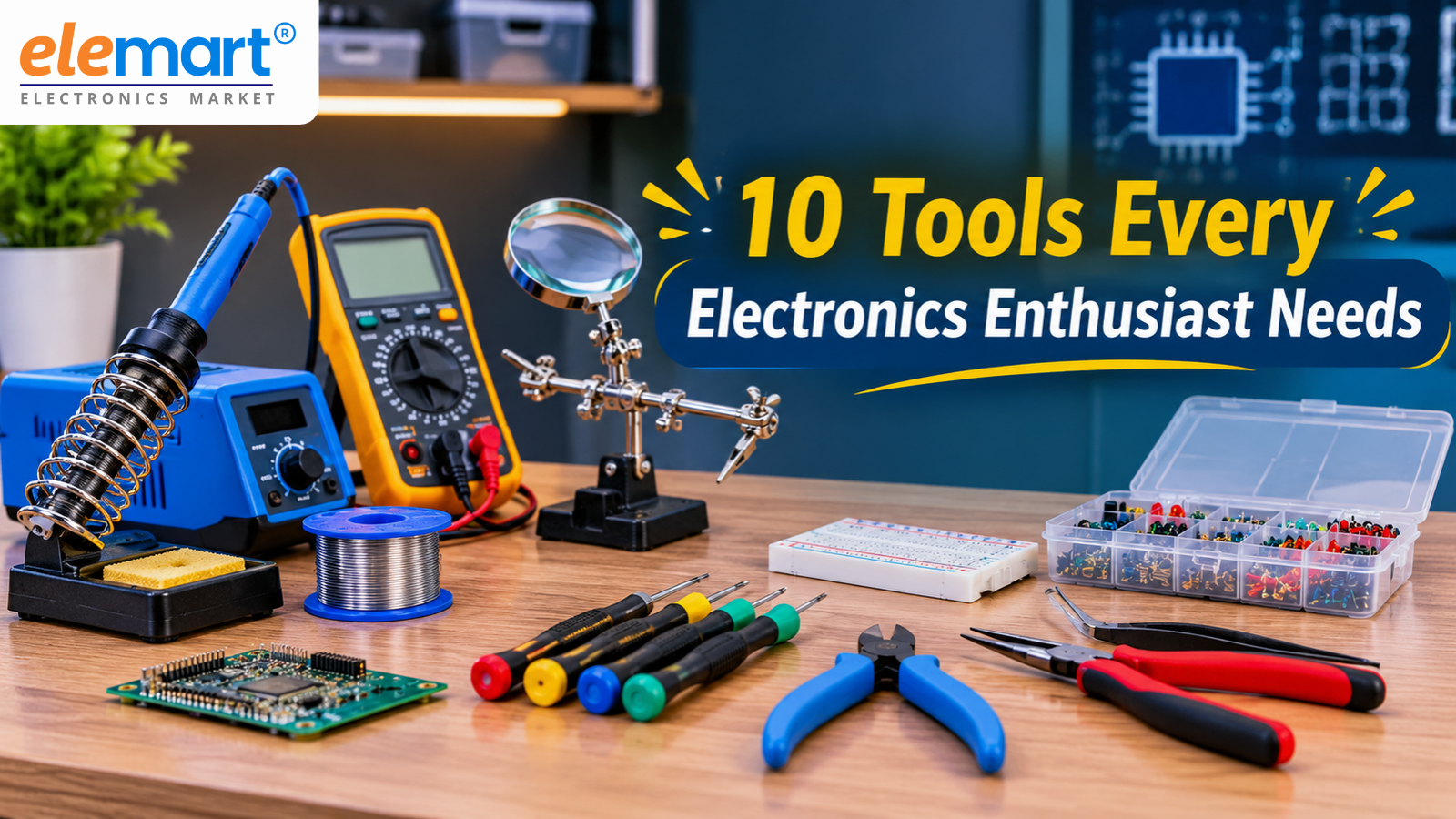
To help you build the perfect workspace, we have created this essential workbench checklist featuring 10 must-have electronics tools every electronics enthusiast should own.
Whether you are setting up your first electronics lab or upgrading your existing workspace, this guide will help you choose the right tools for your needs.
Why Do You Need a Proper Electronics Workbench?
An electronics workbench is more than just a table where you assemble circuits. It is a dedicated workspace that allows you to design, build, test, repair, and experiment with electronic components safely and efficiently.
Having the right electronics workbench tools offers several advantages:
- Improved accuracy: Precision tools help you take reliable measurements and avoid circuit errors.
- Better productivity: Having essential equipment within reach saves time during projects.
- Easy troubleshooting: Testing instruments help identify faults and diagnose circuit problems.
- Enhanced safety: Proper tools and protective equipment reduce the risk of electrical accidents.
- Professional results: Quality tools help create cleaner, more reliable electronic assemblies.
Now, let's explore the 10 essential tools that deserve a place on every electronics enthusiast's workbench.
10 Essential Tools Every Electronics Enthusiast Needs
1. Digital Multimeter – The Foundation of Every Electronics Workbench
A digital multimeter (DMM) is one of the most important tools for anyone working with electronics. It allows you to measure different electrical parameters and troubleshoot circuits effectively.
Whether you are testing a simple LED circuit or diagnosing a complex electronic board, a digital multimeter helps you understand what is happening inside the circuit.
Key functions of a digital multimeter:
- Measures AC and DC voltage.
- Measures AC and DC current (depending on the model).
- Checks resistance values.
- Performs continuity testing.
- Tests diodes and, on some models, capacitance.
Why do you need it?
Imagine building a circuit that refuses to work. Instead of randomly replacing components, you can use a multimeter to check voltage levels, identify broken connections, and locate possible faults.
Buying tip: Look for a digital multimeter with good accuracy, auto-ranging functionality, continuity testing, and overload protection. Beginners should choose a reliable, easy-to-use model.
2. Soldering Iron – For Building Reliable Connections
A soldering iron is an essential tool for assembling and repairing electronic circuits. It uses controlled heat to melt solder and create electrical connections between components and circuit boards.
From attaching resistors and capacitors to repairing damaged PCB connections, soldering is a fundamental skill in electronics.
What to look for in a soldering iron:
- Adjustable temperature control.
- Comfortable ergonomic handle.
- Replaceable soldering tips.
- Fast heating capability.
- Stable temperature performance.
Why do you need it?
Many electronic projects require components to be mounted on printed circuit boards (PCBs). A good soldering iron helps you create neat, secure, and reliable solder joints.
Buying tip: Choose a temperature-controlled soldering iron or soldering station for better control and versatility. Always use an appropriate temperature for the components and soldering task.
3. Digital Oscilloscope – Visualise Electrical Signals
A digital oscilloscope is an advanced testing instrument that allows you to observe how electrical signals change over time.
Unlike a multimeter, which displays numerical measurements, an oscilloscope provides a visual representation of voltage signals in the form of waveforms.
This makes it particularly useful when working with digital circuits, microcontrollers, communication systems, and signal-processing applications.
Important oscilloscope features:
- Bandwidth.
- Sampling rate.
- Number of input channels.
- Waveform triggering.
- Signal measurement capabilities.
Why do you need it?
An oscilloscope helps you analyse signal behaviour, identify noise, examine pulse-width modulation (PWM), and troubleshoot timing-related problems.
For students, engineers, and advanced electronics hobbyists, it is an invaluable instrument for understanding circuit performance.
Buying tip: Consider your project's frequency range, required bandwidth, and sampling rate before purchasing an oscilloscope.
4. Bench Power Supply – Reliable Power for Your Projects
A regulated bench power supply is another must-have instrument for an electronics workbench.
Electronic circuits require specific voltage and current levels to operate correctly. A bench power supply provides controlled electrical power, allowing you to test circuits without depending on batteries or fixed power adapters.
Key features to consider:
- Adjustable output voltage.
- Adjustable current limiting.
- Stable regulated output.
- Overcurrent protection.
- Short-circuit protection.
- Clear digital display.
Why do you need it?
Suppose you are developing a microcontroller-based project or testing a newly assembled PCB. A variable DC bench power supply lets you adjust voltage and set current limits according to the circuit's requirements.
This makes testing more controlled and helps protect components from excessive current.
Buying tip: Choose a regulated DC bench power supply with adjustable voltage and current limits based on the power requirements of your projects.
5. Wire Stripper and Precision Wire Cutter – For Clean Wiring
Working with electronic circuits often involves handling wires of different sizes and insulation types.
A wire stripper removes insulation without damaging the conductor, while a precision wire cutter helps trim wires and component leads neatly.
These simple tools are essential for creating organised and professional-looking electronic assemblies.
Why do you need them?
Poorly stripped wires can result in damaged conductors, loose connections, or short circuits. Precision wire cutters also make it easier to prepare component leads and organise PCB assemblies.
What to look for:
- Adjustable stripping sizes.
- Sharp cutting edges.
- Comfortable grip.
- Durable construction.
- Compatibility with commonly used wire gauges.
Buying tip: Invest in a quality wire stripper and flush cutter to make everyday electronics work easier and more precise.
6. Precision Screwdriver Set – For Assembly and Repair
Electronic devices frequently use small screws that cannot be handled easily with standard household screwdrivers.
A precision screwdriver set provides different screwdriver tips designed for delicate electronic equipment, circuit enclosures, connectors, and small mechanical assemblies.
Common screwdriver types include:
- Phillips screwdrivers.
- Flathead screwdrivers.
- Torx screwdrivers.
- Hex screwdrivers.
- Precision security bits.
Why do you need it?
Whether you are opening an electronic enclosure, assembling a project box, or repairing a device, the correct screwdriver helps prevent damaged screw heads and surrounding components.
Buying tip: Choose a precision screwdriver kit with magnetic tips, an ergonomic handle, and a wide selection of commonly used bits.
7. Helping Hands Tool with Magnifying Glass – Better Precision While Working
Soldering small components and handling delicate circuit boards can be challenging, especially when both hands are occupied.
A helping hands tool solves this problem by holding PCBs, wires, and other small objects securely while you work.
Many models also include a magnifying glass that makes it easier to inspect small solder joints and component markings.
Benefits of a helping hands tool:
- Holds PCBs in a stable position.
- Keeps wires in place during soldering.
- Provides additional magnification.
- Improves precision during assembly.
- Reduces unnecessary hand movement.
Why do you need it?
When working with surface-mount devices (SMDs), small connectors, or delicate wires, stability is extremely important. A helping hands tool makes detailed work more manageable.
Buying tip: Look for a model with adjustable clamps, a stable base, and a magnifying glass with suitable magnification.
8. Desoldering Pump and Desoldering Wick – Correcting Soldering Mistakes
Mistakes are part of learning electronics. Sometimes you may install a component incorrectly, create a solder bridge, or need to replace a damaged component.
This is where desoldering tools become essential.
A desoldering pump and desoldering wick help remove unwanted solder from PCB pads and component connections.
Desoldering pump:
A desoldering pump uses suction to remove molten solder from a joint.
Desoldering wick:
A desoldering wick is a braided copper strip that absorbs molten solder through capillary action.
Why do you need them?
These tools allow you to correct soldering errors, remove components, and clean PCB pads during repair work.
Buying tip: Keep both tools on your workbench. A desoldering pump is useful for removing larger amounts of solder, while solder wick is particularly helpful for cleaning pads and removing solder bridges.
9. ESD Protection Equipment – Protect Sensitive Electronic Components
Modern electronic components can be sensitive to electrostatic discharge (ESD). Even a small static discharge from your body can potentially damage sensitive integrated circuits, microcontrollers, and semiconductor devices.
ESD protection equipment helps minimise this risk while handling electronic components.
Essential ESD protection accessories include:
- ESD wrist strap.
- ESD-safe work mat.
- ESD-safe storage bags.
- ESD-safe component handling tools.
Why do you need it?
When handling sensitive electronic components, electrostatic discharge can cause immediate failure or hidden damage that affects long-term reliability.
Using an appropriate ESD-safe workspace helps protect components during assembly, testing, and repair.
Buying tip: Choose a properly grounded ESD wrist strap and mat, and follow the manufacturer's grounding and safety instructions. ESD protection is especially important when working with MOSFETs, integrated circuits, and other static-sensitive components.
10. Component Storage Organiser – Keep Your Workbench Clutter-Free
A well-organised workbench is just as important as having quality testing instruments.
Electronic projects involve numerous small components, including resistors, capacitors, LEDs, transistors, connectors, and integrated circuits.
Without proper storage, these components can easily get mixed up or misplaced.
A component storage organiser helps you keep everything in its proper place.
What should your organiser include?
- Multiple small compartments.
- Clearly labelled sections.
- Separate storage for different component types.
- Anti-static storage for sensitive components where required.
- Easy-access drawers or containers.
Why do you need it?
A properly organised component inventory saves time, reduces component loss, and makes project development more efficient.
Buying tip: Select modular storage boxes or drawer organisers with transparent compartments and labels so you can identify components quickly.
Bonus: Essential Accessories to Complete Your Electronics Workbench
While the 10 tools mentioned above cover most basic electronics workbench requirements, a few additional accessories can make your workspace even more functional.
Here are some useful additions:
Accessory | Purpose |
|---|---|
Breadboard | Build and test prototype circuits without soldering |
Jumper wires | Connect components during prototyping |
Solder wire | Create electrical connections |
Tweezers | Handle small electronic components |
Heat shrink tubing | Insulate wire connections |
Smoke absorber | Help capture soldering fumes |
Safety glasses | Protect your eyes during electronic work |
Cleaning brush | Remove dust and debris from PCBs |
These accessories are especially useful for DIY electronics projects, prototyping, PCB assembly, and electronic repair.
How to Set Up the Perfect Electronics Workbench
Buying the right tools is only the first step. Organising your workspace properly is equally important.
Follow these simple tips to create an efficient electronics workbench:
1. Choose a stable work surface
Select a sturdy table with enough space for your soldering station, testing instruments, and electronic projects.
2. Ensure proper lighting
Good lighting helps you identify small components, read markings, and inspect solder joints accurately.
3. Organise tools by usage
Keep frequently used tools, such as your multimeter, wire cutters, soldering iron, and screwdrivers, within easy reach.
4. Manage cables properly
Use cable organisers and clips to prevent tangled wires and maintain a clean working environment.
5. Follow electrical safety practices
Never work on energised circuits unless the task specifically requires it and you are qualified to do so. Disconnect power before making changes, verify that capacitors are discharged, and use appropriately rated equipment.
6. Maintain your tools regularly
Clean soldering tips, inspect test leads, check wire cutters, and store instruments properly after every project.
A clean, organised, and safe workspace improves your overall electronics development experience.
How to Choose the Right Electronics Workbench Tools?
Not every electronics enthusiast needs expensive professional equipment. Your tool selection should depend on your experience, project requirements, and budget.
Consider these factors before purchasing electronics lab equipment:
- Project requirements: Identify whether you mainly work on circuit prototyping, PCB assembly, electronic repairs, or embedded systems.
- Accuracy: Choose reliable measurement instruments that meet your project's requirements.
- Build quality: Durable tools offer better long-term value.
- Ease of use: Beginners should prioritise user-friendly equipment.
- Safety features: Look for appropriate electrical protection and ESD safety features.
- Future requirements: Choose versatile tools that can support more advanced projects as your skills develop.
Most importantly, invest in essential tools first and gradually expand your workbench as your technical knowledge grows.
Conclusion
A well-equipped electronics workbench is the foundation of every successful electronics project. Whether you are experimenting with your first LED circuit, building a microcontroller project, repairing a PCB, or developing advanced electronic systems, the right tools can make your work more accurate, efficient, and enjoyable.
From a digital multimeter and soldering iron to an oscilloscope, bench power supply, and ESD protection equipment, each tool serves a specific purpose in your electronics journey.
You don't need to purchase everything at once. Start with the essential tools, understand their applications, and gradually build a workspace that meets your project requirements.
Ready to upgrade your electronics workbench?
Explore quality electronics tools, components, testing instruments, and accessories at elemart. Find the equipment you need to turn your electronics ideas into working projects!
Frequently Asked Questions (FAQs)
1. What are the most important tools for an electronics beginner?
A digital multimeter, temperature-controlled soldering iron, wire stripper, precision screwdriver set, breadboard, jumper wires, and basic ESD protection equipment are excellent starting points for beginners.
2. Do I need an oscilloscope for basic electronics projects?
An oscilloscope is not essential for every beginner project. However, it becomes extremely useful when analysing waveforms, checking digital signals, troubleshooting timing issues, and working with more advanced circuits.
3. Which soldering iron is best for electronics projects?
A temperature-controlled soldering iron or soldering station with adjustable temperature, replaceable tips, and stable heat output is generally a good choice for electronics work.
4. Why is a digital multimeter important for electronics?
A digital multimeter helps measure voltage, current, and resistance. It also supports continuity and diode testing, making it an essential instrument for circuit troubleshooting and electrical measurements.
5. How can I protect electronic components from static electricity?
Use an ESD wrist strap, grounded ESD-safe mat, and suitable component storage