If you're learning electronics, you have probably already come across resistors, LEDs, transistors, microcontrollers, and sensors. But there is another tiny component that appears in almost every electronic circuit—and it is often overlooked.
Yes, we're talking about capacitors.
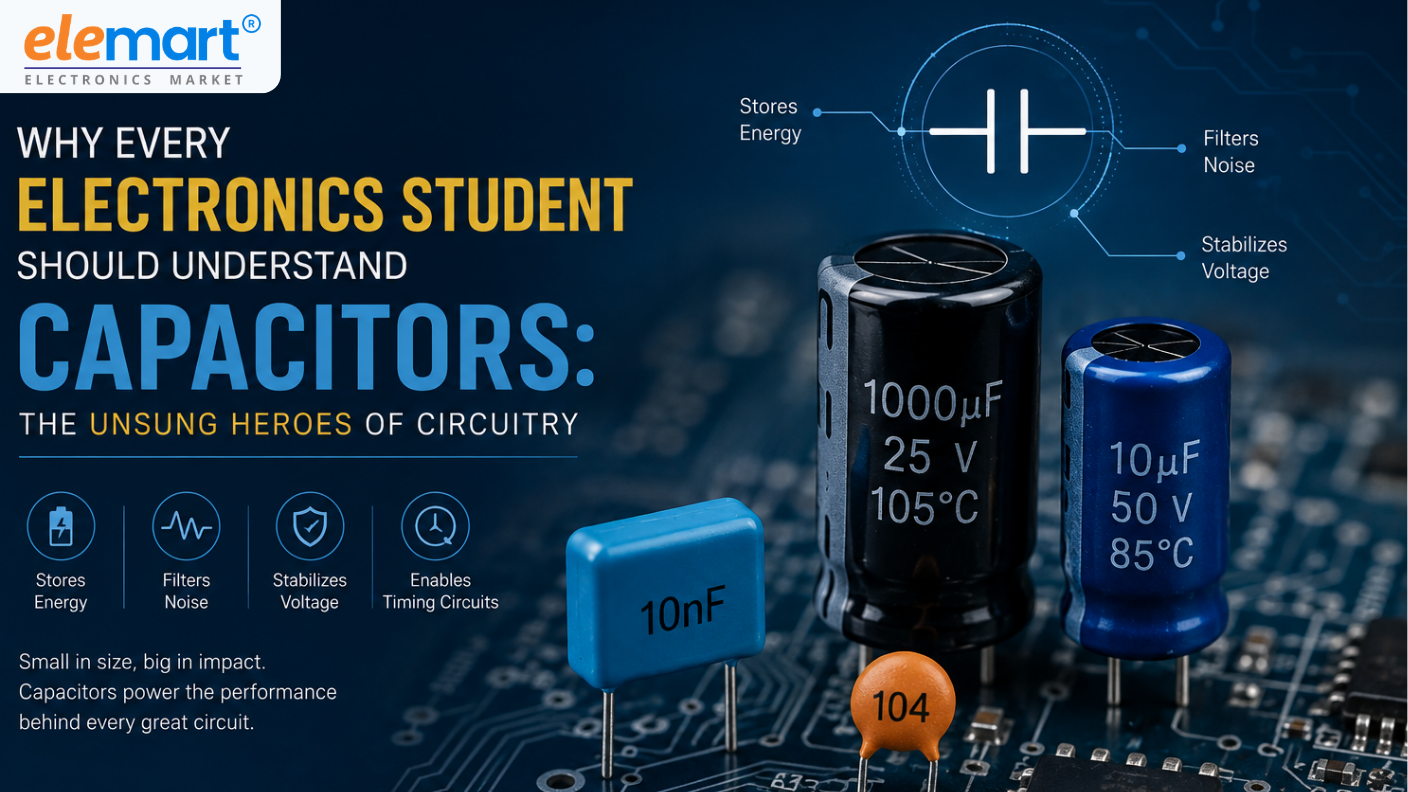
They may look like simple little components, but capacitors play a huge role in keeping electronic circuits stable, filtering unwanted noise, storing electrical energy, and making many devices work properly.
Whether you're a college student building your first circuit, an electronics enthusiast working on an Arduino project, or someone exploring IoT and embedded systems, understanding capacitors in electronics is one of those fundamentals that will help you throughout your electronics journey.
So, let's understand what capacitors actually do and why they matter so much.
What Exactly Is a Capacitor?
In simple terms, a capacitor is an electronic component that stores electrical energy and releases it when needed.
You can think of it as a small temporary energy reservoir inside a circuit.
A capacitor consists of two conductive surfaces separated by an insulating material called a dielectric. When voltage is applied, the capacitor stores energy. When the circuit needs that energy, the capacitor can release it.
The amount of charge a capacitor can store is called capacitance, and it is measured in Farads (F).
In practical electronics, you'll usually see values such as:
- Picofarads (pF)
- Nanofarads (nF)
- Microfarads (µF)
- Millifarads (mF)
But knowing the definition is only the beginning. The real question is:
Why do electronic circuits need capacitors?
Why Are Capacitors So Important in Electronic Circuits?
Imagine you're powering a microcontroller, sensor, or wireless module.
The power supplied to your circuit isn't always perfectly smooth. Changes in current demand can create small voltage fluctuations and electrical noise.This is where capacitors become extremely useful.
Depending on their type and application, capacitors can help:
- Stabilize voltage
- Filter unwanted electrical noise
- Store small amounts of energy
- Smooth power supply output
- Control timing
- Couple AC signals
- Block DC components
- Improve circuit reliability
That's why you will find capacitors everywhere from simple LED circuits to smartphones, computers, automobiles, industrial machines, robots, and IoT devices.
A Simple Example: Why Does Your Circuit Need a Capacitor?
Suppose you're working on an Arduino or ESP32 project.Your microcontroller is connected to a sensor and a wireless module. When the wireless module suddenly requires more current, the power supply may experience a brief disturbance.This disturbance can sometimes cause unexpected behavior, communication problems, or even a system reset.A properly selected decoupling capacitor placed near the power pins can help handle these rapid changes and keep the local voltage supply more stable.
This is one of the first practical capacitor applications that electronics students should understand.
The Most Common Types of Capacitors
Not all capacitors are the same.Different types of capacitors are designed for different applications. Understanding their differences will help you choose the right component for your electronics projects.
1. Ceramic Capacitors
Ceramic capacitors are among the most commonly used components in modern electronics.
They are small, inexpensive, and particularly useful for high-frequency applications.
You'll often find ceramic capacitors being used for:
- Noise filtering
- Decoupling
- High-frequency circuits
- Microcontroller boards
- Digital electronics
If you've ever worked with an Arduino, ESP32, Raspberry Pi, or similar development board, there's a good chance you've encountered them.
2. Electrolytic Capacitors
Electrolytic capacitors are commonly used when relatively high capacitance is required.
They are frequently found in:
- Power supplies
- Amplifiers
- Voltage regulators
- Audio equipment
- Power filtering circuits
One important thing students need to remember is that many electrolytic capacitors are polarized.That means they have a positive and negative terminal and must be connected correctly.
3. Film Capacitors
Film capacitors use a thin plastic film as their dielectric.They are known for good stability and are commonly used in:
- Audio circuits
- Signal filtering
- Timing circuits
- Power electronics
- Precision applications
4. Tantalum Capacitors
Tantalum capacitors offer relatively high capacitance in compact packages.They are often used when space is limited and stable capacitance is important.However, they are also polarized, so correct voltage and polarity selection are important.
What Are Capacitors Used For?
Now let's get to the part that matters most for anyone learning circuit design.
Here are some of the most common capacitor uses.
1. Filtering Electrical Noise
Electronic circuits can contain unwanted electrical noise.Capacitors can help filter certain unwanted high-frequency signals, making the circuit cleaner and more stable.This becomes especially important in sensitive electronic systems and communication circuits.
2. Smoothing Power Supply Voltage
Power supplies don't always provide perfectly smooth voltage.Capacitors can help reduce fluctuations and smooth the output, which is why they are commonly found in power supply circuits.
3. Decoupling Electronic Components
Decoupling capacitors are commonly placed close to ICs, microcontrollers, sensors, and other electronic components.Their job is to help provide a stable local supply when the component suddenly changes its current demand.This is particularly important in embedded systems and IoT projects, where multiple components may operate simultaneously.
4. Timing and Delay Circuits
When combined with a resistor, a capacitor can create an RC circuit.The charging and discharging behavior of the capacitor can be used to create:
- Time delays
- Pulse shaping
- Oscillations
- Timing functions
This makes RC circuits an excellent practical experiment for electronics students.
5. Energy Storage
Capacitors can temporarily store electrical energy and release it when required.Although standard capacitors store much less energy than batteries, they can deliver energy quickly, making them useful for short-duration applications.
Capacitors and Arduino, Raspberry Pi & IoT Projects
If you're an electronics student, chances are you've worked with or are planning to work with development boards.Arduino, Raspberry Pi, ESP32, sensors, displays, motors, and wireless modules are commonly used in student projects.Understanding capacitors can make these projects much easier to troubleshoot.For example, if a sensor gives unstable readings or a wireless module behaves unexpectedly, the problem may not always be the software.
It could be related to:
- Power fluctuations
- Electrical noise
- Poor decoupling
- Incorrect component selection
- Inadequate power filtering
This is why understanding basic electronic components is just as important as learning how to program a microcontroller.
How Do You Choose the Right Capacitor?
One of the biggest mistakes beginners make is choosing a capacitor only by looking at its capacitance value.There are several things you should check before selecting a capacitor for a circuit.
Capacitance
This tells you how much charge the capacitor can store.For example, 100 nF and 100 µF capacitors have very different characteristics and applications.
Voltage Rating
Every capacitor has a maximum voltage rating.Always make sure the capacitor's voltage rating is appropriate for your circuit.
Capacitor Type
Ceramic, electrolytic, film, and tantalum capacitors have different characteristics.The correct choice depends on what the circuit needs.
Polarity
Some capacitors are polarized while others are notAlways check the markings and datasheet before connecting a polarized capacitor.
Tolerance
A capacitor's actual capacitance may vary slightly from its stated value. Tolerance becomes particularly important in precision and timing circuits.
What Happens If You Use the Wrong Capacitor?
Choosing the wrong capacitor doesn't necessarily mean your circuit will immediately fail—but it can cause problems.
For example, an incorrect capacitor may result in:
- Poor filtering
- Excessive electrical noise
- Unstable voltage
- Incorrect timing
- Reduced circuit performance
- Component damage in certain situations
That's why learning to read capacitor specifications and datasheets is an important skill for every electronics student.
Capacitors Are Small but Their Impact Is Huge
One of the interesting things about electronics is that some of the smallest components can have some of the biggest jobs.A capacitor might occupy only a few millimeters of space on a PCB, but it can help determine whether a circuit operates smoothly or behaves unpredictably.Once you start looking at circuit diagrams differently, you'll notice capacitors everywhere.
They are inside:
- Smartphones
- Computers
- TVs
- Cars
- Power supplies
- Audio equipment
- Robots
- Industrial machines
- IoT devices
- Development boards
- Consumer electronics
That's what makes learning capacitor basics so valuable.You're not learning something that applies to only one type of project. You're learning a concept that appears across almost the entire electronics industry.
The Best Way to Learn Capacitors? Build Something.
Reading about capacitors is useful, but actually using them is much better.If you're a student, try experimenting with a few simple circuits.You could build:
- An RC charging circuit
Watch how a capacitor charges and discharges over time. - A simple LED circuit
Experiment with different capacitor values and observe the circuit's behavior. - A power filtering circuit
See how capacitors affect voltage fluctuations. - An Arduino or ESP32 project
Use a decoupling capacitor and understand why it is positioned near the power pins. - A simple audio or signal circuit
Experiment with capacitors to understand signal coupling and filtering.These small experiments can turn an abstract electronics concept into something you can actually see and measure.
Why Capacitors Should Be Part of Every Electronics Student's Fundamentals
As you progress from basic circuits toPCB design, embedded systems, robotics, automation,IoT, and advanced electronics, you will keep coming back to the same fundamental components.
Capacitors are one of them.
You don't need to become an expert in capacitor technology on day one. But you should understand:
- What a capacitor does
- How capacitance works
- The different capacitor types
- Where capacitors are used
- How to read capacitor ratings
- How to select the right capacitor
- Why capacitors are important in practical circuits
Once these concepts become familiar, circuit diagrams become easier to understand and troubleshooting becomes much more logical.
Final Thoughts
Capacitors might not be the most exciting components in an electronics lab. They don't have the visual appeal of a display, the intelligence of a microcontroller, or the movement of a motor.
But they quietly perform some of the most important jobs inside electronic circuits.
From power filtering and voltage stabilization to signal processing, timing, and energy storage, capacitors help electronic systems work reliably.
So, if you're an electronics student, don't just memorize the definition of a capacitor for your next exam.
Understand what it does, why it's there, and how it affects the circuit.
That knowledge will stay useful whether you're building your first breadboard project today or designing advanced IoT, embedded, robotics, or PCB-based systems tomorrow.
Frequently Asked Questions About Capacitors
What is a capacitor in electronics?
A capacitor is a passive electronic component that stores electrical energy and releases it when required. Capacitors are widely used for filtering, timing, voltage smoothing, signal coupling, and decoupling.
What are the main types of capacitors?
Common types include ceramic, electrolytic, film, and tantalum capacitors. Each type has different characteristics and is suited to different circuit applications.
What is a capacitor used for in a circuit?
Common capacitor uses include filtering electrical noise, smoothing power supply voltage, decoupling components, creating timing circuits, coupling signals, and temporarily storing electrical energy.
Which capacitor is commonly used for circuit decoupling?
Ceramic capacitors are commonly used for decoupling because of their suitability for handling rapid changes and high-frequency noise.
Why should electronics students learn about capacitors?
Capacitors are used across almost every area of electronics. Understanding them helps students design, build, and troubleshoot circuits more effectively, from basic breadboard projects to Arduino, IoT, embedded, robotics, and PCB projects.