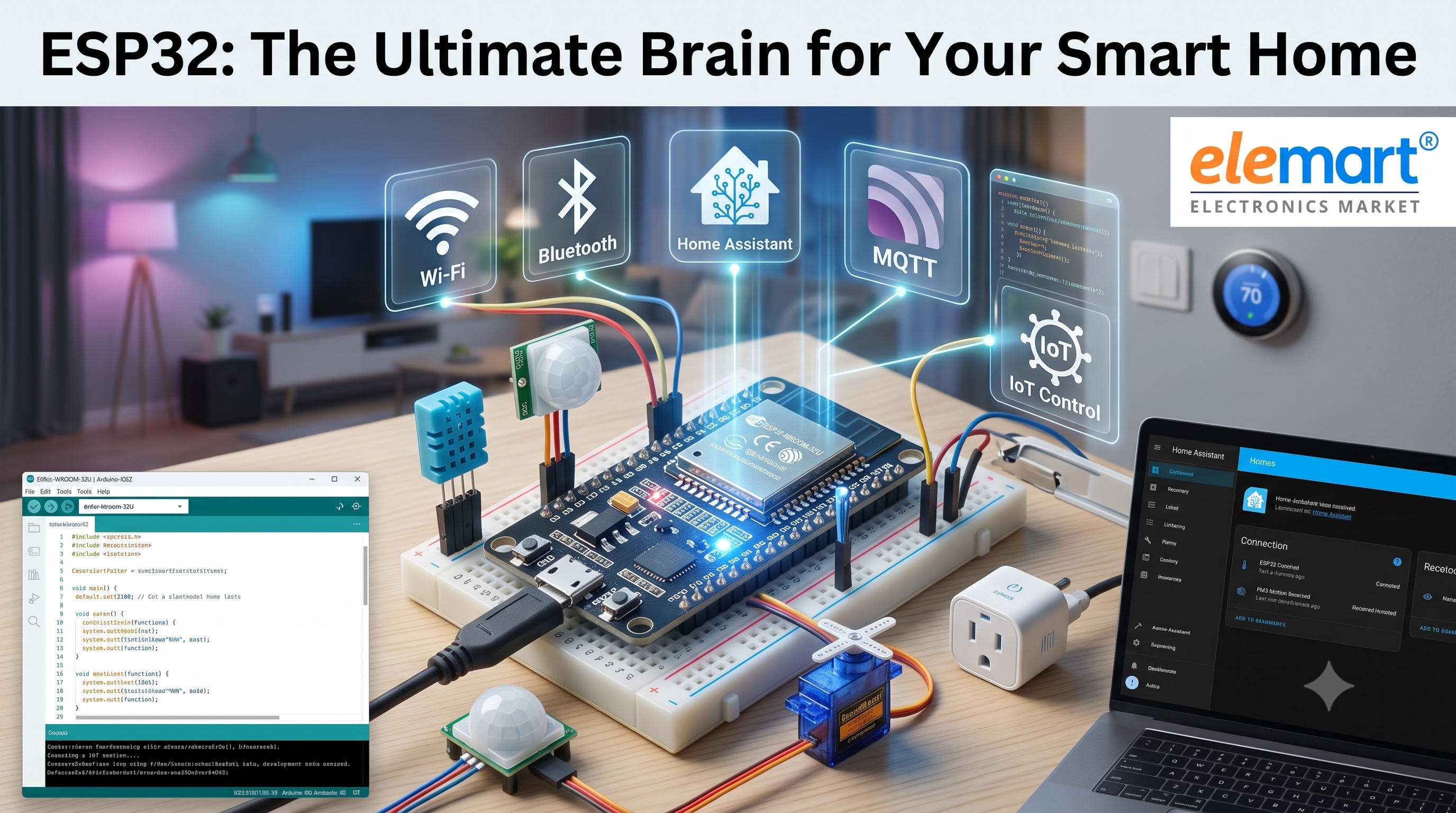
The smart home revolution is no longer a futuristic dream—it’s happening right now, in living rooms, kitchens, and garages around the world. At the heart of countless DIY automation projects lies a tiny, affordable, and incredibly powerful microcontroller: the ESP32. Whether you’re a seasoned maker or just starting your journey into home automation, the ESP32 offers an unmatched blend of connectivity, processing power, and flexibility. In this blog, we’ll explore what makes the ESP32 so special and why it’s hands-down the best choice for your next smart home project. Plus, we’ll show you where to grab your own ESP32 boards right here at EleMart.com.
What Is the ESP32?
The ESP32 is a low-cost, low-power system-on-chip (SoC) developed by Espressif Systems. It’s the successor to the wildly popular ESP8266, but with a massive upgrade in capabilities. The chip integrates Wi-Fi, Bluetooth (Classic and BLE), dual-core processing, and a rich set of peripherals—all on a single piece of silicon. It’s available in a variety of development boards, from the classic ESP32 DevKit to compact modules like the ESP32-C3 and ESP32-S3, making it adaptable to almost any project size.
Key Features That Make the ESP32 a Smart Home Powerhouse
1. Built-in Wi-Fi & Bluetooth – No Extra Modules Needed
The ESP32’s most obvious advantage is its seamless wireless connectivity. With 2.4 GHz Wi-Fi (802.11 b/g/n) and Bluetooth 4.2/BLE, you can connect your devices directly to your home network, communicate with smartphones, or create mesh networks without adding external radios. This slashes component count, cost, and complexity—perfect for compact smart home sensors and actuators.
2. Dual-Core Processing & Ample Memory
Unlike many microcontrollers that struggle with multitasking, the ESP32 features a dual-core Tensilica LX6 processor (or a single-core RISC-V in newer variants) running up to 240 MHz. It packs up to 520 KB of SRAM and 4 MB of flash (often 16 MB on modern boards). This means you can run a real-time operating system (FreeRTOS), handle complex sensor fusion, serve a web interface, and maintain a secure MQTT connection—all simultaneously.
3. Ultra-Low Power Modes
Smart home devices often need to run on batteries for months or even years. The ESP32’s deep sleep mode consumes mere microamps, and its ULP (Ultra-Low-Power) co-processor can monitor sensors while the main cores are asleep. Wake-on-timer, touch, or external triggers make it ideal for wireless door/window sensors, temperature loggers, and motion detectors that sip power.
4. Rich Peripheral Set
The ESP32 is a GPIO powerhouse. It offers:
- Multiple SPI, I2C, UART interfaces
- Up to 18 ADC channels (12-bit)
- 2 DAC channels (8-bit)
- Capacitive touch sensors (great for hidden buttons)
- PWM outputs for LED dimming and motor control
- Integrated Hall effect sensor
- CAN bus, Ethernet MAC, and more
This means you can interface with almost any sensor, display, or actuator without extra chips.
5. Massive Community & Software Ecosystem
The ESP32 is supported by a vibrant open-source community. You can program it using:
- Arduino IDE – beginner-friendly, thousands of libraries
- ESP-IDF (Espressif IoT Development Framework) – professional-grade, full control
- MicroPython – rapid prototyping with Python
- ESPHome – YAML-based firmware specifically for smart home integration
- Tasmota – pre-built firmware for common devices
For smart home enthusiasts, ESPHome and Tasmota are game-changers. They allow you to create custom sensors and switches that integrate natively with Home Assistant, openHAB, or Node-RED without writing a single line of code.
6. Security Features
Modern smart homes demand security. The ESP32 includes hardware-accelerated encryption (AES, SHA, RSA), secure boot, and flash encryption. This helps protect your network from unauthorized access and ensures your data stays private.
7. Cost-Effectiveness
Perhaps the most compelling reason: you can get a fully-featured ESP32 development board for the price of a coffee. When you’re building dozens of sensors around the house, that affordability adds up fast. At EleMart, we offer a wide range of ESP32 boards at competitive prices, so you can scale your smart home without breaking the bank.
Why ESP32 Beats Other Controllers for Smart Home Projects
Feature | ESP32 | Arduino Uno (ATmega328P) | Raspberry Pi Pico W |
|---|---|---|---|
Wi-Fi & Bluetooth | Built-in | Requires shield | Wi-Fi only (Pico W) |
Processor | Dual-core 240 MHz | Single-core 16 MHz | Dual-core 133 MHz |
RAM | 520 KB SRAM | 2 KB | 264 KB |
Flash | 4–16 MB | 32 KB | 2 MB |
Low Power | Excellent (deep sleep ~5 µA) | Limited | Good |
Smart Home Firmware | ESPHome, Tasmota, ESP RainMaker | None native | Limited |
Price (approx.) | $3–$10 | $20+ | $6–$10 |
While the Raspberry Pi Pico W offers Wi-Fi and a competitive price, it lacks Bluetooth and the mature smart-home firmware ecosystem that ESP32 enjoys. Traditional Arduinos simply can’t keep up with the connectivity demands of a modern smart home.
Real-World Smart Home Projects You Can Build with ESP32
- Multi-Sensor Node – Combine temperature, humidity, motion, and light sensors into one tiny, battery-powered device that reports to Home Assistant via MQTT.
- Smart LED Controller – Use the ESP32 with addressable LEDs (WS2812B) to create under-cabinet lighting, ambient TV backlighting, or a sunrise alarm clock, all controllable from your phone.
- Bluetooth Proxy for Home Assistant – Turn an ESP32 into a BLE gateway to track Bluetooth devices (like phones or beacons) for presence detection.
- Voice-Controlled IR Blaster – Control your old air conditioner or TV by adding an IR LED and integrating with Alexa or Google Assistant through ESP RainMaker.
- Energy Monitor – Interface with current clamps and voltage sensors to track whole-home or per-circuit energy consumption, sending data to a dashboard.
- Smart Plant Watering System – Read soil moisture, activate a water pump, and log data—all powered by a small solar panel and the ESP32’s deep sleep.
The possibilities are endless, and the ESP32’s flexibility means you can start simple and expand functionality over time.
Get Your ESP32 Boards at EleMart.com
Ready to start building? At EleMart.com, we stock a curated selection of genuine ESP32 development boards, modules, and accessories to jumpstart your smart home journey. Here are some of our top picks:
- ESP32 DevKit V1 (30-pin) – The classic workhorse, perfect for prototyping. Includes CP2102 USB-to-UART, 4 MB flash, and breadboard-friendly layout.
- ESP32-C3 SuperMini – Tiny, low-cost RISC-V board with Wi-Fi and BLE 5.0. Ideal for space-constrained sensors.
- ESP32-S3 Dev Board – Next-gen with AI acceleration, USB OTG, and more GPIO. Great for voice and display projects.
- ESP32-CAM Module – Add a camera to your smart home for video doorbells, pet monitors, or security.
- ESP32 Ethernet Kit – For wired reliability in network-heavy setups like energy monitors or central controllers.
Browse our full ESP32 Collection to find the perfect board for your project. We offer fast shipping, competitive prices, and dedicated support to help you succeed.
Conclusion
The ESP32 microcontroller has rightfully earned its place as the go-to platform for smart home enthusiasts. Its built-in wireless connectivity, powerful processing, low power consumption, and unparalleled software ecosystem make it the best choice for everything from simple sensors to complex automation hubs. Whether you’re automating lights, monitoring your home’s energy, or building a custom voice assistant, the ESP32 gives you the tools to do it affordably and reliably.
Don’t wait to make your home smarter. Visit EleMart.com today, pick up an ESP32 board, and start turning your smart home ideas into reality. Happy making!