Every engineering student eventually faces the same challenge: turning a textbook concept into a working project before the submission deadline. Electronics projects are where theory meets reality, and this transition is often harder than it looks. Wiring mistakes, unreliable modules, complicated code, and last-minute connectivity issues can turn a promising idea into a stressful few weeks.
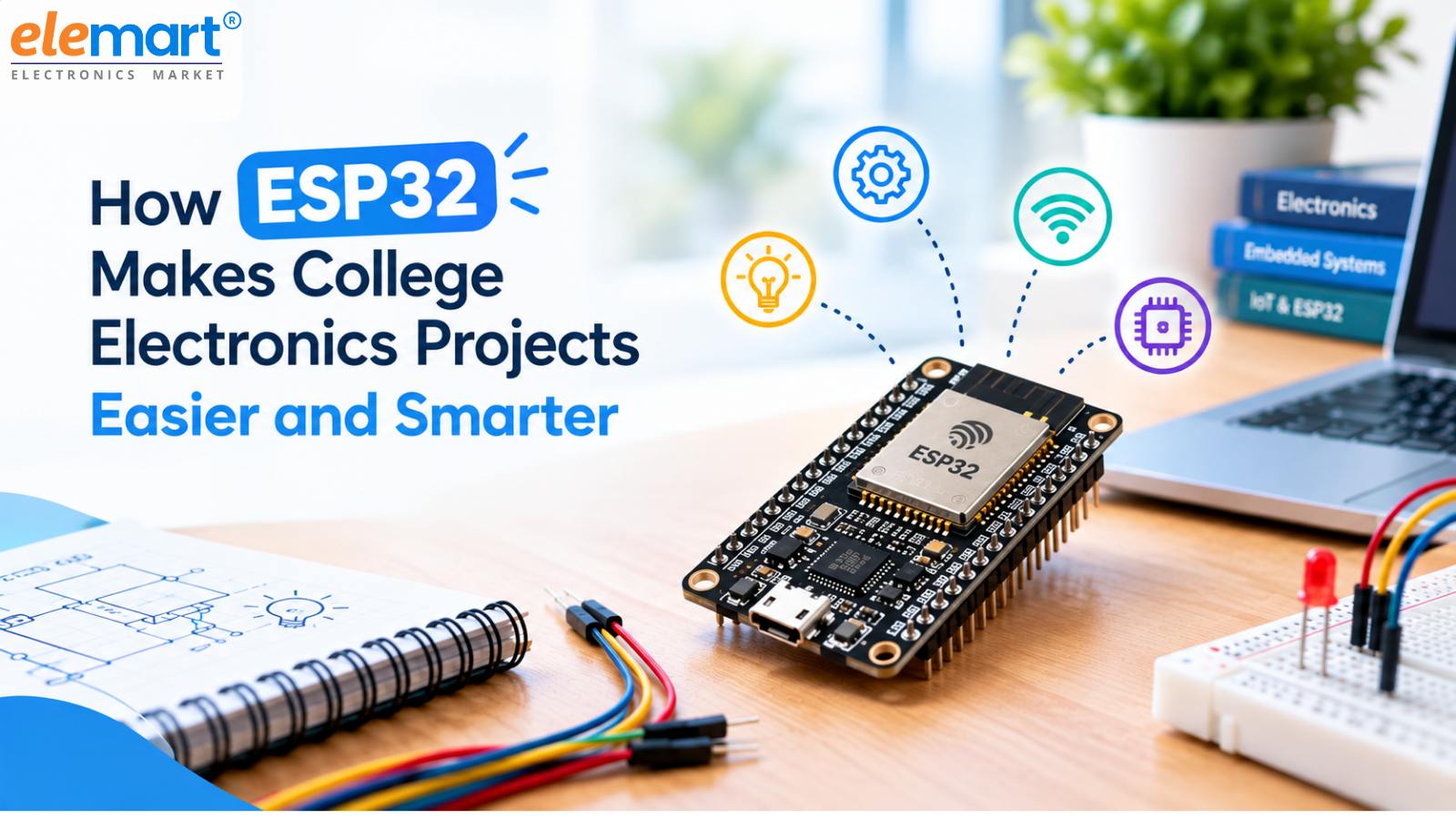
This is where the ESP32 for college projects has changed the experience for thousands of engineering students. Instead of juggling multiple boards, modules, and communication shields, students can now rely on a single, affordable platform that combines processing power, Wi-Fi, Bluetooth, and enough input/output pins to handle most academic projects.
The ESP32 development board has become a popular choice for engineering students because it supports everything from basic electronics experiments to advanced ESP32 IoT projects.
This guide explains why the ESP32 has become the preferred development board for college projects, what makes it easier to work with, and how students can plan and build smarter, IoT-ready projects using it.
Understanding the ESP32 Development Board
The ESP32 is a low-cost, low-power system-on-chip microcontroller developed by Espressif Systems. Unlike traditional microcontrollers that only handle basic input and output operations, the ESP32 integrates a dual-core processor along with built-in Wi-Fi and Bluetooth connectivity.
This means students no longer need a separate Wi-Fi shield or Bluetooth module to add wireless features to a project. The development board handles sensor reading, data processing, and wireless communication on a single board, making it ideal for smart, connected college electronics projects.
Its compatibility with the Arduino IDE also means students who already know basic Arduino programming can start using the ESP32 with very little additional learning. This makes the ESP32 a practical option for ESP32 projects for engineering students who want to explore IoT without having to learn a completely new programming environment.
Why the ESP32 Matters for College Projects
Many students underestimate how much the choice of development board affects the outcome of a project. A board with limited processing power or no connectivity options can restrict what a student is able to build, no matter how good the idea is.
Choosing the for college projects provides several advantages:
- Fewer components and simpler wiring
- Built-in wireless connectivity for IoT projects
- Lower overall project cost
- Familiar programming environment
- Easier debugging and troubleshooting
- Room to scale the project into something more advanced later
- Support for a wide range of sensors and modules
- Suitable for mini-projects as well as final-year engineering projects
These advantages directly translate into saved time, fewer failed demonstrations, and stronger evaluation outcomes.
For students looking for the best ESP32 board for college projects, the key advantage is its combination of affordability, processing capability, wireless connectivity, and flexibility.
Define Your Project Requirements First
Before finalizing any hardware, it is important to clearly understand what the project actually needs to do.
What is the core function of the project?
Understanding the primary goal helps determine which sensors, outputs, and features are actually necessary. A simple monitoring system may require only a few components, while an advanced ESP32 engineering project may need multiple sensors, displays, motors, and communication interfaces.
Does the project need internet or app connectivity?
If the project needs to send data to a dashboard, a phone app, or trigger remote alerts, built-in wireless connectivity becomes essential.
This is one of the major advantages of using an development board for IoT projects. Wi-Fi and Bluetooth are already integrated, reducing the need for additional communication hardware.
How much processing power is required?
Simple monitoring tasks need minimal processing, while projects involving multiple sensors or real-time data handling need more capable hardware.
Understanding the processing requirements beforehand helps students select the appropriate ESP32 variant for their application.
How many sensors and modules will be connected?
This determines how many GPIO and analog pins the board needs to support.
Students working on ESP32 sensor projects should also check the communication protocols used by their sensors, such as I2C, SPI, UART, or digital and analog inputs.
Will the project run on battery power?
Portable or remote projects require attention to power consumption and sleep modes.
The ESP32 supports low-power operating modes that can be useful for battery-powered IoT applications.
Answering these questions early prevents costly redesigns later in the project and helps students choose the best ESP32 board for their college project.
Consider Processing and Connectivity Needs
The ESP32's dual-core processor allows it to manage multiple tasks efficiently, such as reading sensor data while handling Wi-Fi communication. For college projects, this means the board can process incoming data while maintaining network connectivity, which is especially useful for live-monitoring and alert-based systems.
On the connectivity side, the ESP32 supports both Wi-Fi and Bluetooth out of the box. This is particularly useful for:
Wi-Fi-Based ESP32 Projects
Students can use Wi-Fi to send data to cloud dashboards, mobile applications, websites, or remote servers for live monitoring.
This makes the ESP32 an excellent choice for ESP32 IoT projects for college students, particularly when remote monitoring or internet connectivity is required.
Bluetooth-Based ESP32 Projects
Bluetooth enables short-range control and data exchange, making it useful for robotics, wearable devices, home automation, and other demonstrations.
Because both Wi-Fi and Bluetooth are built into the chip, students save the cost and wiring complexity of adding separate communication modules.
Understanding the ESP32 Board Family
Not all ESP32 boards are identical. Depending on the project, one variant may be more suitable than another.
ESP32 Dev Board
The standard and most widely used version is suitable for most general-purpose ESP32 engineering projects and college electronics projects.
It provides a practical combination of GPIO, processing capability, wireless connectivity, and compatibility with common development tools.
ESP32-CAM
The ESP32-CAM includes a built-in camera module, making it ideal for projects involving image capture, face detection, surveillance, and basic computer vision.
Students can use it for ESP32-CAM projects involving smart security systems, image monitoring, and camera-based automation.
ESP32-C3
The ESP32-C3 is a smaller, single-core variant suited for simpler, cost-sensitive, or space-constrained projects.
It can be a good option when the project does not require the additional capabilities of larger ESP32 variants.
ESP32-S3
The ESP32-S3 offers additional processing capabilities and AI acceleration features, making it useful for projects involving voice recognition, computer vision, and edge AI applications.
Selecting the right variant ensures the board matches the project's actual requirements instead of paying for capabilities that won't be used.
Students searching for the best ESP32 board for college projects should consider processing requirements, GPIO availability, wireless connectivity, physical size, power requirements, and the type of sensors or modules being used.
Consider ESP32 Power Consumption
Power efficiency matters most for projects that need to run continuously or operate on battery power, such as remote environmental monitors or wearable devices.
The ESP32 supports deep sleep and low-power modes, allowing it to conserve energy between readings. For a college project, this can be the difference between a device that lasts a few hours on battery and one that runs reliably through an entire demonstration day.
Understanding\ low power consumption and deep sleep mode can help students create more efficient battery-powered applications.
For example, an environmental monitoring system can wake the ESP32 periodically, collect sensor readings, transmit the data, and return to sleep instead of continuously consuming power.
Evaluate ESP32 GPIO and Input/Output Requirements
Every project depends on the sensors, displays, and actuators connected to it. Before finalizing the design, it helps to calculate:
- The number of sensors required
- The number of outputs needed, such as motors, relays, or displays
- Any additional communication interfaces required
- The number of available ESP32 GPIO pins
- The number of analog inputs required
- Room for adding one or two extra components later
The ESP32 offers a generous number of GPIO and analog interfaces, which is usually sufficient for most academic-level projects without needing an external expansion board.
For sensor projects, students should also check the voltage requirements and communication protocol of each sensor before connecting it to the board.
Proper planning at this stage can prevent wiring problems and component conflicts during the final stages of the project.
Consider Software Support and Community Resources
One of the strongest advantages of the ESP32 is the size of its developer community. Because it is widely used for IoT projects, students can find documentation, sample code, libraries, and troubleshooting guides for almost any sensor or use case.
This community support significantly reduces the time spent debugging and allows students to focus more on understanding the underlying concepts rather than fighting unfamiliar hardware.
The ESP32 Arduino IDE environment is also helpful for students who already have experience with Arduino programming. Students can use familiar programming concepts while gaining access to Wi-Fi, Bluetooth, and other ESP32 capabilities.
This makes the learning curve relatively manageable for beginners while still providing enough flexibility for advanced ESP32 IoT development.
Popular ESP32 Project Ideas for College Students
There are countless ESP32 project ideas for engineering students, ranging from simple sensor-based projects to advanced connected systems.
Smart Home Automation
A Wi-Fi-controlled switchboard, automated plant watering system, smart lighting system, or app-controlled smart doorbell can make excellent ESP32 smart home projects.
Students can demonstrate how sensors, actuators, wireless communication, and programming work together to create a connected home environment.
Security and Access Control
An RFID or fingerprint-based smart door lock, motion-triggered security alert system, or connected access-control system can demonstrate the practical use of the ESP32 in security applications.
These projects can also be expanded by adding Wi-Fi notifications or a mobile application.
Environmental and Health Monitoring
An air-quality monitoring station with a live dashboard or a wearable monitoring system with app-based alerts can demonstrate real-world ESP32 IoT development.
Students can connect sensors to measure environmental conditions and transmit the collected data to a remote dashboard.
Energy Monitoring
A smart energy meter that tracks real-time power consumption and displays the information remotely is another practical ESP32 engineering project.
This type of project combines sensors, data processing, wireless connectivity, and visualization.
Robotics
A Wi-Fi- or Bluetooth-controlled robot, obstacle-avoiding rover, or remotely controlled robotic vehicle can combine motors, sensors, wireless communication, and programming.
These ESP32 robotics projects are particularly useful for demonstrating both hardware and software skills during a college project presentation.
Each of these ideas can be scaled to fit a short mini-project or expanded into a full final-year submission, depending on the number of features and sensors added.
Common ESP32 Project Mistakes to Avoid
Even with a capable development board, students can run into problems if the project is not planned and tested properly.
Some common mistakes include:
- Skipping the breadboard testing stage before finalizing a design
- Underestimating the power requirements of motors or displays
- Leaving Wi-Fi and cloud dashboard integration for the last few days
- Copying code without understanding how it works
- Not testing the project under real conditions, only in short demo runs
- Ignoring ESP32 GPIO and voltage requirements
- Choosing incompatible sensors or modules
- Not keeping spare components available for the final demonstration
Avoiding these mistakes early on leads to a smoother build process and a more confident final presentation.
Students should test each section of the project separately before integrating all components. This makes ESP32 project troubleshooting much easier and helps identify hardware or software problems before the final demonstration.
ESP32 vs Arduino vs Raspberry Pifor College Projects
Students often ask which board is right for their specific project. Understanding ESP32 vs Arduino vs Raspberry Pi can help students select the right hardware.
Arduino
Arduino boards remain an excellent starting point for simple, offline control tasks such as basic sensor readings or motor control, particularly for first-year students learning core concepts.
If a project does not require internet connectivity or advanced processing, Arduino can still be a practical choice.
ESP32
The ESP32 is the better choice when a project needs wireless connectivity, whether that means sending data to an app, a cloud dashboard, or triggering remote alerts, while still remaining affordable and beginner-friendly.
For most connected IoT projects for college students, the ESP32 provides an excellent balance of cost, processing capability, wireless connectivity, and ease of development.
Raspberry Pi
Raspberry Pi becomes the preferred option when a project needs a full operating system, camera-based processing, or heavier computing tasks such as running machine learning models.
For most connected, IoT-style college projects, the ESP32 offers an excellent balance of cost, capability, and ease of use.
Where to Buy Genuine ESP32 Development Boards
The reliability of a college project depends heavily on the quality of its components. A genuine ESP32 board with proper documentation and support avoids the wiring inconsistencies and driver issues sometimes found with unbranded alternatives.
A trusted electronics platform should offer a wide selection of development boards, along with compatible sensors, communication modules, and accessories needed to complete a project without last-minute sourcing delays.
Elemart provides a wide range of genuine boards and development modules, along with the sensors and accessories students need to bring their college projects to life.
For students planning an engineering project, having access to compatible boards, sensors, modules, and accessories from one source can make project planning and procurement easier.
Conclusion
Choosing the ESP32 for college projects removes much of the friction that used to slow students down: extra modules, unfamiliar toolchains, and complicated wireless setups.
With built-in Wi-Fi and Bluetooth, strong community support, multiple GPIO interfaces, and compatibility with tools students already know, the development board allows more time to be spent on the actual engineering and less on fighting the hardware.
Whether the goal is a simple weekend mini-project or an ambitious final-year submission, starting with the right board makes the entire process easier, smarter, and far less stressful.
From IoT projects and smart home automation to robotics, environmental monitoring, security systems, and energy management, the ESP32 provides engineering students with a flexible platform for building practical and innovative projects.
Elemart offers a complete range of ESP32 boards and accessories to help students plan, build, and submit their next ESP32 engineering project with confidence.
This version keeps your original blog content and flow, while adding the SEO terms naturally and highlighting them in bold so your team can easily review the keyword placement.