- Jul 13, 2026
Share this post on:
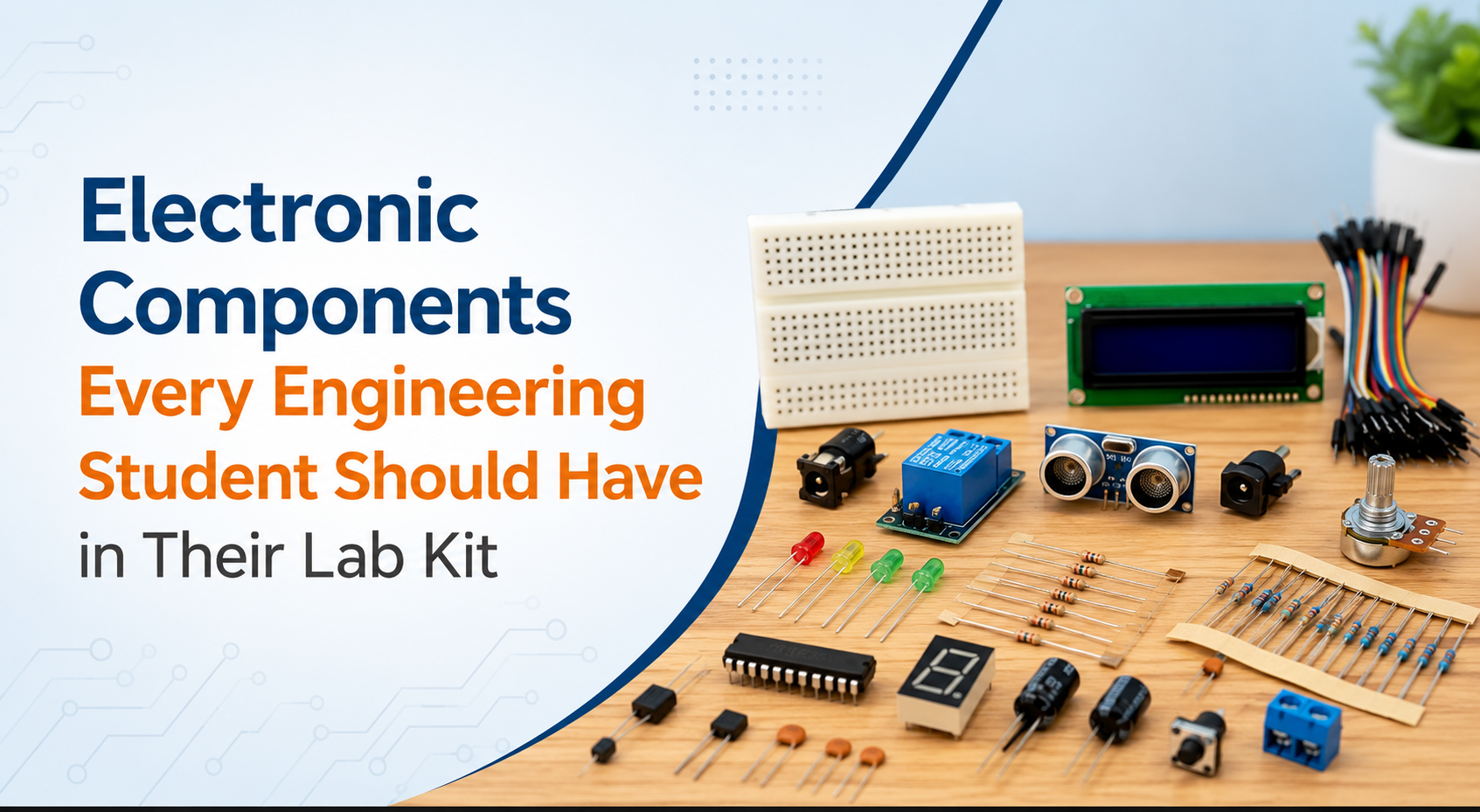
The electronics industry is expanding rapidly, creating exciting opportunities for engineering students to build careers in embedded systems, IoT, robotics, automation, telecommunications, and semiconductor technologies. According to market estimates, the global electronic components market is expected to grow from USD 0.77 trillion in 2026 to USD 1.38 trillion by 2034, registering a CAGR of 7.47% during the forecast period.
This remarkable growth highlights the increasing demand for skilled engineers with strong practical knowledge of electronic components and circuit design. While theoretical concepts provide the foundation, hands-on experience with essential components is what transforms students into confident problem-solvers. A well-equipped electronics lab kit enables students to experiment, prototype, troubleshoot, and develop innovative projects efficiently.
In this blog, we'll explore the top electronic components every engineering student should have in their lab kit to enhance practical learning and prepare for successful careers in the ever-evolving electronics industry.
Key Takeaways
- Having essential electronic components enables engineering students to bridge the gap between classroom theory and hands-on circuit design.
- Resistors, capacitors, inductors, and potentiometers play a crucial role in current control, energy storage, filtering, and voltage regulation.
- Platforms like Arduino Uno and ESP32 help students build real-world projects in IoT, robotics, embedded systems, and automation while enhancing programming and hardware integration skills.
- A multimeter, breadboard, jumper wires, soldering kit, and voltage regulators help students assemble, troubleshoot, and validate circuits efficiently, ensuring accurate and reliable project outcomes.
- Temperature, motion, gas, humidity, and ultrasonic sensors introduce engineering students to smart systems, automation, and data acquisition.
- Reliable components improve circuit performance, reduce failures, and provide a smoother learning experience, helping engineering students develop industry-ready practical skills.
Essential Passive Electronic Components Every Student Should Own
Passive electronic components form the backbone of every electrical and electronic circuit. They regulate voltage, store electrical energy, filter signals, and protect sensitive components from damage. Mastering these components helps engineering students understand circuit fundamentals before moving on to complex embedded systems and automation projects.
1. Resistors
Resistors are among the first electronic components every engineering student encounters. They control current flow, divide voltages, and protect LEDs, sensors, and integrated circuits from excessive current. A lab kit should include resistors with various resistance values and power ratings for different experimental requirements.
Control electrical current safely
Used in voltage divider circuits
Available in multiple resistance values
Essential for nearly every electronics project
2. Capacitors
Capacitors temporarily store electrical energy and release it when required. They are widely used for filtering noise, stabilizing power supplies, timing circuits, and signal coupling. Both ceramic and electrolytic capacitors should be included in an engineering student's electronics toolkit.
Store and release electrical charge
Filter voltage fluctuations
Improve power supply stability
Used in analog and digital circuits
3. Inductors
Inductors store energy in magnetic fields and are commonly found in power supplies, filters, converters, and communication circuits. Understanding inductors helps students learn electromagnetic principles and switching power electronics used in industrial applications.
Store magnetic energy
Used in DC-DC converters
Reduce electrical noise
Important for power electronics
4. Potentiometers
Potentiometers are variable resistors used to adjust voltage, current, and signal levels. Students frequently use them in sensor calibration, motor speed control, audio circuits, and Arduino projects where adjustable resistance is required.
Adjustable resistance control
Used in calibration circuits
Ideal for prototype testing
Supports analog input experiments
Active Components and Development Boards That Power Innovation
Active electronic components perform switching, amplification, processing, and control functions in electronic systems. These devices transform simple circuits into intelligent systems capable of automation, communication, and data processing. Engineering students should familiarize themselves with these components to develop industry-ready practical skills.
1. LEDs
Light Emitting Diodes (LEDs) are widely used for indication, testing outputs, and learning digital logic. Different colored LEDs help students visualize circuit behavior while practicing programming, microcontroller interfacing, and electronic troubleshooting.
Visual output indicators
Low power consumption
Easy to interface with controllers
Available in multiple colors
2. Diodes
Diodes allow current to flow in only one direction, protecting circuits from reverse polarity and voltage spikes. They are commonly used in rectifiers, voltage regulation circuits, and signal processing applications.
One-way current flow
Protect sensitive circuits
Used in rectifier circuits
Essential for power electronics
3. Transistors
Transistors function as electronic switches and amplifiers. Whether using BJTs or MOSFETs, students learn circuit switching, signal amplification, and motor control through transistor-based practical experiments.
Electronic switching device
Signal amplification
Motor control applications
Foundation of modern electronics
4. Integrated Circuits (ICs)
Integrated Circuits combine multiple electronic components into compact chips that perform complex functions. Popular ICs like the 555 Timer, Op-Amps, logic gates, and voltage regulators help students understand analog and digital electronics.
Compact electronic circuits
Enable complex operations
Reduce circuit size
Widely used in projects
5. ESP32 Development Board
ESP32 has become one of the most popular development boards for IoT and embedded systems. It features built-in Wi-Fi, Bluetooth, multiple GPIO pins, ADCs, DACs, PWM, and dual-core processing, making it ideal for engineering students.
Built-in Wi-Fi and Bluetooth
Supports IoT applications
Powerful dual-core processor
Compatible with Arduino IDE
6. Arduino Uno
Arduino Uno is an excellent beginner-friendly microcontroller board that simplifies programming and hardware interfacing. Students use it for robotics, automation, sensor integration, and embedded system development.
Easy programming environment
Large community support
Ideal for beginners
Supports numerous sensors
Essential Testing Tools, Sensors, and Accessories for Practical Learning
Electronic components alone cannot complete a laboratory setup. Testing instruments, connectors, sensors, and prototyping accessories are equally important for assembling, measuring, debugging, and validating electronic circuits. These tools improve accuracy, simplify troubleshooting, and prepare engineering students for professional hardware development.
1. Breadboard
Breadboards allow students to build circuits without soldering. They make experimentation faster, reduce component damage, and simplify debugging during electronics practical sessions.
Key Points:
No soldering required
Reusable for multiple projects
Easy circuit modifications
Ideal for prototyping
2. Jumper Wires
Jumper wires connect electronic components on breadboards and development boards. A combination of male-to-male, male-to-female, and female-to-female wires ensures compatibility with various hardware modules.
Key Points:
Flexible circuit connections
Available in multiple configurations
Reusable and durable
Simplify prototyping
3. Voltage Regulators
Voltage regulators provide stable output voltage regardless of input fluctuations. They protect sensitive electronics and ensure reliable operation of microcontrollers, sensors, and communication modules.
Key Points:
Stable voltage output
Protect electronic devices
Improve circuit reliability
Essential for power management
4. Multimeter
A digital multimeter measures voltage, current, resistance, and continuity. It is one of the most valuable tools for diagnosing circuit problems and verifying electrical measurements during laboratory work.
Key Points:
Measures electrical parameters
Detects faulty components
Supports troubleshooting
Essential diagnostic equipment
5. Sensors
Engineering students frequently work with temperature, humidity, motion, gas, ultrasonic, IR, and light sensors. These components introduce real-world automation concepts and are widely used in IoT and robotics projects.
Key Points:
Collect environmental data
Enable automation projects
Support embedded applications
Easy microcontroller integration
6. Connectors and Headers
Reliable connectors improve circuit stability and simplify module interfacing. USB connectors, pin headers, terminal blocks, JST connectors, and DC jacks are useful additions to every electronics toolkit.
Key Points:
Secure electrical connections
Simplify hardware assembly
Improve project durability
Reduce loose connections
Conclusion
Building a comprehensive electronics lab kit is one of the smartest investments an engineering student can make. Having the right combination of passive components, active devices, development boards, sensors, testing equipment, and connectors enables faster learning, practical experimentation, and successful project development. These components not only support academic coursework but also prepare students for internships, industrial training, hackathons, research, and future engineering careers. As technology continues to evolve, hands-on experience with quality electronic components becomes increasingly valuable for solving real-world engineering challenges.
At Elemart, we are committed to providing engineering students, educators, hobbyists, and professionals with high-quality electronic components, development boards, testing tools, and accessories at competitive prices. Whether you're building your first circuit or developing advanced IoT and embedded systems, Elemart offers reliable products that help turn innovative ideas into successful projects. Start building your electronics lab kit today and take the next step toward engineering excellence.
Frequently Asked Questions
1. Why should engineering students build their own electronics lab kit?
A personal electronics lab kit allows students to practice independently, complete academic projects, improve troubleshooting skills, and gain practical experience beyond classroom learning.
Encourages hands-on learning
Supports project development
Improves technical confidence
Enhances practical skills
2. Which development board is best for beginners: Arduino or ESP32?
Arduino Uno is ideal for beginners because of its simple programming environment, while ESP32 is better for advanced IoT, wireless communication, and embedded applications.
Arduino is beginner-friendly
ESP32 supports Wi-Fi and Bluetooth
Both have large communities
Suitable for different learning levels
3. What testing equipment is essential for an electronics lab kit?
A digital multimeter, breadboard, jumper wires, soldering kit, power supply, and wire stripper are the most important testing and prototyping tools for engineering students.
Multimeter for measurements
Breadboard for prototyping
Jumper wires for connections
Soldering tools for permanent circuits
4. How do quality electronic components improve learning?
High-quality components reduce circuit failures, provide accurate performance, increase project reliability, and help students understand electronic concepts more effectively through successful experimentation.
Better circuit performance
Improved reliability
Fewer troubleshooting issues
Longer component lifespan
5. Where can engineering students buy reliable electronic components?
Students should purchase components from trusted electronics suppliers that offer genuine products, competitive pricing, technical support, and a wide selection of electronic parts and development boards.
Buy from trusted suppliers
Choose genuine components
Compare pricing and quality
Look for technical support